 YouTube
 Spotify
 Amazon
 iHeart
 Apple
Apple
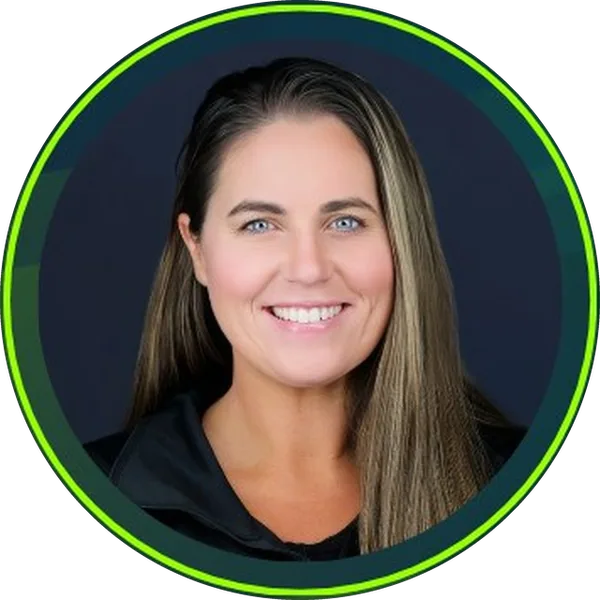
Reghan Brandt
Reghan Brandt is the Chief Digital Operations Officer at K2 Insurance Services, where she leads digital transformation across multiple insurance divisions. She is also the founder of LossRun Pro and President of Columbia Pacific Finance. With two decades of experience building and modernizing insurance operations, Reghan is a practitioner of the people-first philosophy: understand the business before you modernize it.
The full episode
Press play for the whole conversation.

Why Insurance Modernization Fails (And How to Do It Right)
There's a story that defines Reghan Brandt's approach to insurance. She's at a wedding. She's had a few cocktails. An insurance agent mentions premium financing. She has no idea what that is, but she nods convincingly anyway. The next morning, hungover at 6 AM, she Googles "premium financing," learns what it actually means, and - by pure chutzpah - gets hired to lead the business.
That job became Columbia Pacific Finance.
This origin story isn't just cute trivia. It reveals something fundamental about Reghan's philosophy: domain expertise comes from immersion, not theory. Not everyone can pull off a bluff at a wedding and build a company from it. But everyone can understand the principle: you have to get your hands dirty. You have to understand the business before you try to modernize it.
This lesson shaped every subsequent venture. When Reghan started learning the insurance business in earnest, she didn't join a think tank or attend a conference. She drove from Seattle through Wyoming - literally stopping at independent agent offices, one by one, asking questions, listening, learning. At 24 years old. That's not a summer internship. That's a commitment to understanding.
Today, Reghan is Chief Digital Operations Officer at K2 Insurance Services, a multi-division insurance company facing the very real challenge of modernization at scale. And her perspective on why modernization projects fail - and how to make them work - cuts through the hype and gets to the actual barriers.
The Real Barrier: Change Management, Not Technology
Here's what most companies get wrong: they believe insurance modernization is a technology problem. Pick the right software. Implement it well. Done.
Reghan disagrees. "The tech you can build anything now. It's going to be change management."
This might sound simple, but it's profound. Consider what modernization actually requires in an insurance organization:
1. Articulating hidden workflows: Insurance professionals - underwriters, adjusters, agents - have decades of knowledge living in their heads. They make decisions based on intuition shaped by years of experience. When you ask them to explain exactly how they underwrite a risk or adjust a claim, they can't. Not because they're being evasive, but because so much of their process is implicit. "I just know it when I see it." Digitizing that is brutally hard. You can't code what you can't describe.
2. Building buy-in across the organization: When you implement new technology, you're asking people to change how they work. That's threatening. It challenges expertise built over decades. It introduces uncertainty. The person who was the fastest underwriter on the old system might be slow on the new one (at first). That's demoralizing. Building genuine buy-in requires addressing fears, training thoroughly, and - critically - showing that the new system makes their job better, not just more compliant.
3. Managing the edge cases: Software demos always look perfect. "Here's a standard case, flowing through the happy path, everything works great." Real insurance is nothing like the happy path. State regulations vary. Policies have quirks. Claims have complexities. Edge cases break every system. Managing those edge cases requires subject matter experts working alongside technology vendors - not handing off responsibility once the software is installed.
Why InsurTech 1.0 Failed: No Boots on the Ground
The early wave of InsurTech (roughly 2010-2016) was characterized by a particular approach: young tech entrepreneurs from Silicon Valley looked at insurance, saw inefficiency, and said "we can fix this with software." Many of these founders had never read an insurance policy. They didn't understand state regulation. They'd never sat with an agent or an underwriter. They just saw "market opportunity."
Their goal was often to disintermediate - to cut out agents, replace underwriters with algorithms, "disrupt" an industry they viewed as hopelessly outdated.
Reghan's take on this wave? "InsurTech 1.0 was cynical."
What failed wasn't the technology. It was the assumption that you could modernize an industry without understanding it. You can't replace agents without understanding why agents exist and what value they provide. You can't automate underwriting without understanding the judgment calls and the edge cases that make underwriting an art, not a formula. You can't build state-compliant systems without understanding state regulation.
The founders who succeeded weren't the ones with the fanciest technology. They were the ones who got their boots on the ground, learned the business, and built solutions that made the existing ecosystem more efficient rather than trying to blow it up.
Reghan exemplifies this approach: Columbia Pacific Finance (premium financing), LossRun Pro (loss run aggregation and distribution), and now K2 (operational transformation). Each venture started with a deep understanding of a specific pain point in the insurance value chain. Not a solution looking for a problem. A problem understood intimately, then solved with appropriate technology.
Data Transparency Builds Loyalty; Hoarding Builds Friction
Here's a question that reveals how insurance companies often think: How do we keep customers from leaving?
Some answer: "Make it difficult to leave. Hoard their data. Create lock-in. Make switching costs so high that they stay because leaving is painful."
Reghan's answer is different: "You don't want to only keep business because you made it so difficult to move."
This is a data-transparency insight. Carriers have access to loss run data, claims history, policy information. Agents need access to this information to do their jobs. But some carriers restrict access, reasoning that if their customers can't easily access their own data, they're locked in.
Reghan's pushback: that's backward. Restriction creates friction. Friction creates resentment. Resentment drives customers to look for alternatives. And when they do, they leave - because they were never truly loyal, just captive.
Transparency, by contrast, builds trust. Trust opens the door to longer-term relationships. "Once you get the trust of customers, the sky's the limit."
Know What You're Solving For Before You Buy Software
Here's a pattern Reghan has observed repeatedly: a company sees a competitor adopt new software, or a vendor gives a slick demo, and a decision gets made to buy. Budget gets allocated. Contracts get signed. Implementation begins.
But nobody actually defined what the company is trying to accomplish.
"Sometimes people who are buying software don't even know what they want the outcome to be."
This is a costly mistake. Because when implementation hits reality, when the edge cases emerge, when change resistance surfaces, there's no clear north star. No shared definition of success. Just confusion and frustration.
Reghan's approach flips this: define outcomes first. Then pick software that can deliver those outcomes.
This requires discipline: Getting stakeholders in a room. Asking hard questions. "What are we actually trying to accomplish? Faster underwriting? Better underwriting? Fewer rejections? Higher approval rates? Better customer experience? Lower costs? Happier employees?" These are different outcomes, and they may require different solutions.
The Framework: People, Process, Technology - In That Order
Reghan's approach to modernization is grounded in a simple framework: People, Process, Technology.
Most companies start with Technology. They pick software, implement it, and hope people and process adjust.
Reghan reverses this
1. People first: Who are the users? What do they know? What are they afraid of? What's the change management strategy? How will you build buy-in and capability? This comes before technology.
2. Process second: Given the people involved, what is the actual process we're trying to enable or transform? What are the key steps? Where are the decision points? Where are the edge cases? What training is required? This is where you articulate the implicit knowledge and define how work flows.
3. Technology third: Given the people and process, what technology enables this? Should you buy, build, or partner? What's the implementation plan? How do you support people as they learn new systems? This is where technology serves people and process, not the other way around.
This order is counterintuitive in a tech-forward world. But it's the order that actually works.
The Edge Case Problem: Why Software Breaks in the Real World
All insurance software developers encounter the same problem: demos work great. Real-world usage breaks.
Why? Insurance is full of edge cases. An employee moves to a different state mid-year. A family situation changes. A claim involves unusual circumstances. A policy has been amended three times. The standard workflow doesn't apply. The system breaks.
Reghan's solution: have one clear owner for each technology project. Not a committee. Not consensus. One person responsible for making decisions about how edge cases are handled, what happens when the system doesn't work, and how to escalate issues.
This owner doesn't have to know all the answers. But they have to be empowered to make decisions quickly, escalate appropriately, and own the outcome. Without this clarity, edge cases create confusion, support costs spiral, and user frustration grows.
Key Takeaways
About Reghan Brandt
Title: Chief Digital Operations Officer, K2 Insurance Services
Additional Roles: Founder of LossRun Pro, President of Columbia Pacific Finance
Background: Reghan's career in insurance spans two decades, starting with a wedding-night bluff about premium financing and evolving into operational leadership at scale. She has founded and led successful fintech ventures in insurance premium financing and loss run data management. Her current role at K2 involves overseeing digital transformation across multiple insurance divisions and business units.