 YouTube
 Spotify
 Amazon
 iHeart
 Apple
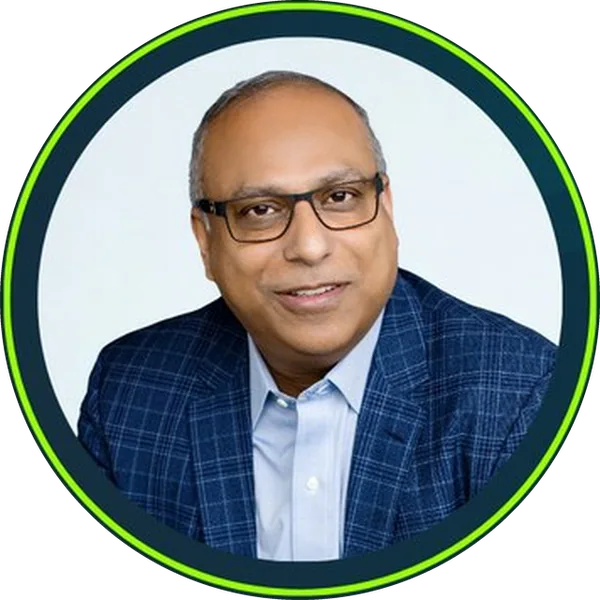
Vineet Bansal
In this episode, hosts James Benham and Rob Galbraith sit down with Vineet Bansal, Chief Information and Technology Officer at The Mutual Group, to explore how technology leadership, AI adoption, and operational strategy are shaping the future of mutual insurance.
Vineet shares his journey from engineering in India to leading large-scale transformations across financial services and insurance. The conversation highlights how mutual insurers - often smaller, community-driven organizations - can modernize and compete through shared platforms, disciplined innovation, and a strong foundation in data and governance.
The full episode
Press play for the whole conversation.

From Agra to Insurance: A Career Shaped by Pivotal Moments
Vineet Bansal's path to insurance technology leadership began thousands of miles from any insurance company. Growing up in Agra, India - the city famous for the Taj Mahal - he was expected to join his father's farming equipment manufacturing business. Instead, a love for engineering took him to Nagpur in southern India, where he shifted from electronics to computer science just as the digital revolution was taking hold.
After graduating and completing his MBA, Vineet joined Ramco Systems as a Siebel CRM consultant and made his way to the United States. His first American assignment was supposed to be at a bank headquartered in the World Trade Center - with a start date of September 11, 2001. He had arrived in New York City just the day before.
That moment redirected everything. Vineet pivoted to Fidelity Investments, where he spent years implementing CRM across multiple business lines and discovered the intellectual depth of financial services. It was through Fidelity Life Insurance that he first encountered annuities and life insurance - beginning a two-decade career in the industry.
"Insurance sits at the intersection of risk, regulation, economics, and human behavior." - Vineet Bansal, CITO at The Mutual Group"
Vineet Bansal
Building a Scalable Model for Mutual Insurers
The Mutual Group represents a new approach to an old challenge. Many mutual insurance companies - community-based carriers that serve policyholders directly - have deep relationships and generational trust, but lack the scale, talent, and technology infrastructure to compete with larger carriers.
Backed by Bain Capital and just two years into its journey, The Mutual Group was formed to bridge that gap. With GuideOne Insurance as its founding member, the organization provides shared technology platforms, operational support, and insurance expertise that individual mutual companies couldn't build alone.
Vineet's approach is distinctly multi-tenant: every technology decision - from data platforms to digital capabilities to AI implementations - is designed to scale across multiple member companies while maintaining the data integrity, security, and regulatory compliance that insurance demands.
"Mutual companies are strong in trust and relationships - but they need help scaling technology and operations." - Vineet Bansal, CITO at The Mutual Group"
Vineet Bansal
AI in Insurance: Discipline Over Speed
A major theme in the conversation is the gap between AI hype and real-world execution in insurance. While AI dominates headlines, Vineet emphasizes that insurance is a deliberately risk-managed industry that cannot move recklessly. Successful AI adoption requires thoughtful implementation, strong governance, and a focus on operational improvement before transformation.
At The Mutual Group, AI is being applied where it delivers immediate, measurable value: document processing, underwriting intake, and first notice of loss. But the key differentiator isn't the AI itself - it's the foundation underneath it.
Vineet's team has invested heavily in clean, structured data; API-driven ecosystems for integration; modernized core systems; and robust security and compliance frameworks. This foundation enables AI to be embedded directly into business workflows - enhancing decision-making for underwriters and claims professionals rather than replacing them.
"AI won't solve your data issues. It's garbage in, garbage out." - Vineet Bansal, CITO at The Mutual Group"
Vineet Bansal
The Future: Personalized Insurance Sold by the Hour
Looking ahead, Vineet sees a major evolution in how insurance products are designed and delivered. Driven by AI and increased data availability, the industry is moving toward highly personalized policies tailored to individual behavior and risk.
This builds on earlier trends - parametric insurance a decade ago, embedded insurance at the point of purchase five years ago - but pushes personalization much further. Vineet envisions insurance products sold by the hour or day, coverage for specific events or activities, and pricing that reflects real-time individual risk rather than broad actuarial categories.
The implications are significant: a skydiver could buy coverage only for the hours they're jumping. A gig worker could have policies that flex with their schedule. The one-size-fits-all era of insurance may be ending.
"We may have insurance products sold by the hour, by the day." - Vineet Bansal, CITO at The Mutual Group"
Vineet Bansal
Key Takeaways
The full transcript
Transcribed automatically from the episode audio, so some names and terms may be misheard.
James BenhamAnd we are back with another great episode of the InsurTech Geek podcast. I am your InsurTech Geek, James Benham. With me, my illustrious cohost, the most interesting man in insurance, mister Rob Galbraith.
Rob GalbraithRob, how are you doing today in beautiful San Antonio, Texas? Doing well, James. Yeah. It is beautiful. We thankfully started to get some of the spring temps for summer temperatures for for many parts of the world. And, I got a special package this morning in the mail. And, for those of you that are only listening, I'm holding up on camera the newly minted Mongolian edition of the Edith Insurance as we know it. Wow. I mean,
James BenhamMongolia's got a pretty decent sized population. So, like, why not? Right? They do. And and,
Rob Galbraiththere's several folks over there. So I won't name it. Nomax Publishing is the company that finally did it together. When my book first came out in 2019, they reached out that year, and they wanted to do it. And and we were hoping to get it done in a year, and it's been quite a journey on their end. But it finally can. I'd give it up. I the hope. I kinda thought it wouldn't be pulled together. But, yeah, I got a notice early last fall that, it was happening, and, my copy finally arrived in the mail.
Need to talk and see if Chad, GBT, or Gemini can translate my book into Mongolian. That'd be fun.
James BenhamThat's exciting. Well, you know, now three and a half million people can unlock their brains on the future of insurance, or the end of insurance as we know it. Right? That's right. That's great. And with us, Vineet, from, the the wintry wilds, not nearly as wintry wilds as two weeks ago of Westchester County up in New York. How are you doing, Vineet? I'm doing great, gents. Hi, everyone.
Vineet BansalWell, I wish I could say it's a springy weather. It's not. But I'm in New York, and we are just recovering from the snow and cold we saw over the past few weeks, and we are still there.
James BenhamSo, James, good to see you. Yeah. Good to see you too. I I was I as I mentioned in our preshow, Vineet, I was just in your neck of the woods in Manhattan and, down in, you know, kind of Times Square and then in South Central Park and then down to Greenwich Village visiting my, my daughter a couple weeks ago. So I got to experience negative seven degree temperatures. It was, painful, brutal, and at one point, I thought my face was gonna fall off, and that was a really special feeling.
So I I do you know, the the problem with me in Texas, I love Texas, is that when the weather is the most beautiful, I am the most miserable because it's when all the plants pollinate and I get severe allergies, which is why if you're listening, no. I don't have a cold. I have cedar allergies, and the cedars are So with that, let's let's, kinda jump into our conversation. It's always good to chat about insurance and Insurtech geeks and fellow technology nerds, but also straight just great to tell about the people that are involved in this industry because this is a people business.
Even as we talk about AI and we all leverage the hell out of AI, at the end of the day, it's people making decisions, and it's still a lot of relationships factor into risk decisions. And so I love diving into the background of people. Puneet, you've got a great background. It looks like you were born and raised in India and then went to your undergrad there. Tell me, like, tell me about your childhood. Like, where did you grow up, and what did you dream of being when you were a kid?
So, James, when I was growing up, and that was in Northern India near New Delhi. I'm from a town called Agra,
Vineet Bansalknown to people for Taj Mahal. It's a beautiful monument. I grew up did my schooling there, and then I left to do my engineering in Southern India, a thousand kilometers of miles away from my home. I'd say when I was growing up, I did not plan to be where I am today. I wanted to be part of my father's business. So we are from a business family. I hold I can help grow his business. I actually started to do it when I was in my high school.
But then my love for engineering took me to Nagpur in Southern India. I did my engineering over there. It was fascinating. I had a really good experience. I could actually step out from the bounds of my family to look into things that were newer to me. And I decided to then do my MBA after I did my engineering. But my four years in Nagpur were very special, and that actually framed a lot of my persona that I have today. And I'm very thankful that I did it.
So what was your dad's business? So my dad is in manufacturing, we were producing equipments that are used for farming. As you know, India is a major farming country. So my dad was building equipments like thrashers and cultivators and things that farmers use to cultivate the crop. Really good business, a business that he was running, and his his father started forty, fifty years back. But that would have kept me in the town, in the community. However, coming out of Agra, going to Nagpur, doing my engineering, and then everything that came after that has definitely given me much broader perspective.
I think a lot of Americans don't think about the ag business in India.
James BenhamAnd of course, you know, India is a third of the land area of The US and it has a lot more people. So its population density is 12 times more densely populated than The US, but there's still a ton of land because of how densely populated cities are. Tons of lands for farming and, of course, some major Indian farming brands exist over here like Mahindra. Right? Yep. And you're right. So population density is roughly roughly 16. Even though India
Vineet Bansalhas more landmass, the concentration is in fewer places. Like even in US, we see East Coast populated, West Coast populated, and then all, you know, Central America may not be as densely populated. India has the same thing. The the city Mumbai, that is the most populated city or it's call it a a full state of Texas, if you wanna call it that way. The the population density is roughly 35 times the density in US. Wow.
James BenhamThat's wild. So what made you when you ended up going into technology, you fall in love with engineering, and then you go to work for one of the largest technology consultancies in the world, Tata. So, like, what was the what was the path there? Yes. So when I joined engineering, I actually
Vineet Bansalwent there to do electronics and electrical engineering. That's the year when computers was starting to be a conversation, a discussion. Visual basic was the language that we were talking about, and it's not long back. But that's what we were doing. When I was going from my first year into my second year is when I did a switch, I could see that computers are becoming more of the conversation than how the electrical circuits are working. So I kind of slowly shifted towards computers, though I stayed in my love with electronics, microprocessing.
And then by the time I I graduated, I was more thinking about your technology transformation and computer science. So I'd say, again, it was being at the right place at the right time that I chose to shift towards computer science. But most importantly, I don't think the type of engineering makes a big difference. It's engineering itself. It helps you think analytically. It helps you do problem solving. It helps you find many ways to figure out a problem. So what I learned through my engineering did make me a very different person that allowed me to then pursue
James Benhamcomputer science even further in my graduation. That's amazing. So you then went into consulting and then Ramco, but then you landed in financial services. And you were in financial services for quite some time. You built a really great career across financial services and then into insurance, private equity backed organizations. Like, how did you find your way into insurance and what's really kept you there now over time? Great question. And I'll share a little bit of story when I came to US.
Vineet BansalSo that came through a consulting company, Ramco Systems, working on Siebel CRM solutions. I was here to work for a bank that was based out of World Trade Center. My first day of work was going to be the day of 09:11. I came just a little bit before that. I did come to New York City on 09:10, a day before for the first time just to check out everything, and that didn't happen. And I feel really sad about what happened that day. Fortunately, I was not in the city when the events were unfolding as I was supposed to go there a few hours later.
But then I was able to pivot and had an offer to join as a consultant in a pharmaceutical company in West Coast, while I also have an option to work for a company, again, as a contractor in Boston. But when I went to their website, I saw that they are in the business of four zero one bracket k. Yeah. I didn't even knew what that business is until somebody I was talking to said, hey. Are you talking about Fidelity Investments? I said, yeah. Fidelity is some they said they are the biggest UK provider, the retirement services.
So I was actually into Siebel CRM. I was not that much functionally business minded, but based on some advice, I did go to Fidelity. That's where I started in financial services in the world of CRM, but I had really good opportunity to work across many different Fidelity companies while we were implementing CRM across different Fidelity business lines. It was fascinating to learn different businesses. It was fascinating to see how Fidelity brokerage works different than Fidelity Asset Management to Fidelity's international financials. And that actually started to mold me more into being a techno functional consultant.
So I went from being a civil architect to being a techno functional architect. I still remember in my first five years, I interfaced with roughly 10 different stability companies, and then further got deeper into insurance, which was through Fidelity Life Insurance Company. That's where I got exposed to annuities and
James Benhamlife insurance roughly twenty years back. Awesome. Awesome. And, you know, I I I fell into insurance and
Rob Galbraithended up falling in love with it over time. Rob, what you got? Yeah. So, Vineet, I'd love to to fast forward to where you are today with the Mutual Group. Maybe you can tell us a little bit more about the company because I I think what you're doing is very
Vineet Bansalunique there. Yes. So Mutual Group is absolutely a remarkable business model that is there to help mutual insurance companies. So as I was talking about me getting into insurance, I think the intellectual depth of insurance and the impact that it can make is what kept me in insurance. As you see, it sits at that intersection of, you know, risk on one side, regulation on the other side, unit economics, and human behavior. So when I think of all of these and bring it to the mutual group, the mutual group is there to help mutual insurance companies, companies that are very close to the policyholders.
They're more community based, you know, smaller organizations. And I'm not talking about the likes of Liberty Mutual or Mass Mutual. They're last large entities. Mass majority of mutuals are mid sized companies based out of few states with few product lines. So my experience moving from different lines of businesses, from life insurance to specialty to commercial, all of that bringing together in the mutual group, are on the journey to help mutual companies operate from a business operations perspective. The whole mutual group mantra is to help mutual companies with operational excellence, with surplus needs, with the insurance expertise.
And we have Guide One Insurance as as a current member
Rob Galbraiththat we are working with. Now, Bene, you mentioned that it's backed by Bain Capital, if I'm not mistaken, and that you really are, a startup. And so I think, as you mentioned, mutual group well, here, mutual group, I think of a company that's been around for Yeah. You know, a century or more, but this is is different. And, really, it's to help some of those older organizations modernize both on the technology side, but also from an operations perspective as well. Is that correct? Yes, Rob. So Mutual Group is only two years
Vineet Bansalin making. We have a founding member, as I was talking about Guide One Insurance, that's a very established insurance company. We started in Iowa with business in all states with five different product lines. But I agree with one thing you were saying. So most insurance companies are 100 plus years old. Guide one is not that old, but the resilience that the insurance companies have shared over the generation is what makes the industry really strong. But mutual companies being small in size don't have the same capacity, the talent, the know how to compete with the bigger players.
At the same time, acceleration in AI. And I know no no interview or podcast can be completed without AI as the word being used many times. But if you look at the the speed of change, with the AI coming in, it's even increasingly becoming important for the mutual companies to look for the depth in technology transformation, the insurance transformation, the insurance experience they have from their generation of being there. So mutual group is there to bridge that gap of bringing the right technology expertise, bringing the right underwriting claims experience, bringing the operational strength to prepare, help, support mutual companies so they can actually be profitable, competitive, and grow
James Benhamlike some of their competitors. That's cool. Very cool. I I wanna I wanna dive into AI because, certainly, you know, my background is in software development. You know, been writing code since 1991. So when I started coding, fell in love with engineering, love building product. Ironically, the first industry that AI is disrupting is the one that you and I fell in love with, which is engineering and product engineering. But coders that built AI trained it on how to write code first so they could accelerate their coding, and and now we have a very, you know, different landscape.
Andrew Yang wrote a very how can we put it? Inflammatory or, you know, he he he wrote a very strong letter that he that he posted on online about the future of work in automation. Of course, he's been calling for universal basic income for a long time, but let's let's just chat about what you think the actual practical impact in the next year of AI is gonna be because I'm in the middle of a bunch of AI implementations at insurance companies, and they're taking quite a long time to get right.
It is actually not easy. It's not fast. It's not simple. There's some, you know, you know, challenges where you have to, you know, do a lot of work validating data. You have to do a lot of work validating models. Can can you walk me through what you think the actual impact's gonna be? I mean, it's a it's a very old multi thousand year old industry insurance, and we're taking a technology that's functionally 75 years old. You look at back at when and when artificial intelligence was first coined as a phrase, you know, roughly 7070 plus years ago.
And now now we're in full tilt deployment of tools across the entire tech stack, and it it is changing the things. I'd I'd just love for you to hear like, let's talk about practical reality, what you think is changing, and what do you think is coming. Sure. So first of all, I would say that in this insurance specifically,
Vineet Bansalwe cannot move fast and bring things. So the whole industry is formed to be deliberately risk managed, and we have to protect the trust of the customers. So AI in general is more about operational capabilities, not a science experiment. And when I think of insurance specifically, James, it's important that what mutual companies are doing in the space of AI is for member protection. Now to your question about AI in software engineering and then AI into insurance business, even at the mutual group, we have started to use some of AI capabilities in our own IT space.
A lot of IT services products have AI now built into it. I wouldn't say that it is mature enough to get the true benefit, as you probably would have heard from some the articles that are out there, McKinsey has talked about it, MIT has a report about it. While AI does a really good job in software development, where it fails, it takes quite a bit of effort to figure that out. So I think that the AI part of software engineering has matured enough to explore it, to start to use it.
But can it be in an autopilot mode? Can it be in Tesla's terms, full self drive mode? No, not yet. It's still in my mind, you know, a couple of years out. Now bringing AI into business operations, there's a lot of use cases. Industry is filled with paper, documents, data, a lot of it. And AI has a unique ability to pass through all of them. So at Mutual Group itself, we're working on several cases of AI that are not very different than what others are doing, but we are doing it very thoughtfully.
We are doing it very methodically. We are embedding AI into our business processes. We are focused on use of AI where automation could not succeed, the RPA from five years back. We are using AI in our first notice of loss process. We are using AI into underwriting submission, but with a measured view to make sure that first we are bringing operational efficiency. Then we are thinking of AIS, let's say, assistant to underwriters, claim adjusters before we start to think about actually
James Benhamreplacing or changing the whole insurance industry. I think you're on mute James. Yeah. James, couldn't Sorry. I one thing I noticed even in in cars, like General Motors in 2013 said that all their fleet would be self driving by 2018 by 2018, and it's been eight more years. And and I'll I'll tell you this, Super Cruise sucks because I actually had it on one of my cars. Now I've got a Tesla Model y now, and it is freaking amazing, and it still makes life threatening mistakes.
So, you know, it tried it tried pulling me into oncoming traffic the other day, and I'm like, nope. Nope. I don't wanna die today. Not today, Satan. Not today. I'm not doing that. So, you know, I I've noticed that the projects just do actually take a while because of data validation. There there is low hanging fruit. There is stuff we can implement quickly, but, you know, I think it I think we've got a ways to go to make sure it works for our regulated industry. Rob?
So, Benito, kinda wanna go back. You mentioned,
Rob Galbraithguide one is kind of the the, you know, first core member, right, of the the mutual group. So using them as an example, right, knowing that, your value proposition is to bring together many mutuals over time and help them, you know, improve their efficiency both in the the technology side, the operation side. Maybe you can kind of walk through, like, what does that diagnosis look like? Are you, taking over their technology stack and running it? Are you migrating it onto a new one? Are you creating a new one?
Just maybe kinda walk through, the technology piece vis a vis as you bring on GuideOne and and hope to bring on other member companies along the way? Sure. So, Rob, GuideOne is our founding members. They
Vineet Bansalare very purpose driven mission driven organization focused on religious or nonprofits. So when the mutual group was formed in collaboration with GuideOne, we did have people from GuideOne, insurance, technology platforms that the business was using that became our starting point. But as part of TMG, we invested or we continue to invest in technology transformation. We did a lot to do employee productivity improvements. We are doing tech modernization, tech upgrades. As we are doing those things, we are keeping in mind that the scale for us has to be a multi tenant, multi member scale.
So while the starting stack is what Guide1 has, a lot of decisions that we have made, especially, you know, since I've started over, you know, roughly a year back, we have Guidewire for Guide1 insurance. But we are exploring what would make sense for the broader slew of mutual companies that we'll be supporting. We are implementing new capabilities for document generation, a new digital platform, a new data platform, and we are thinking of multi tenancy in all of those. But as you know, we are a very heavily regulated industry.
We still have to make sure that data integrity, data separation, data security is at the top of our mind. So we continue to make advancement in modernization, in transformation, the technology space, making sure that the underlying guardrails around regulation and compliance is kept in mind, even in the space of AI. When we are doing AI use cases, we are doing it in a very responsible way that will work for GuideOne insurance, will help tremendously benefit the business operations for GuideOne as well as underwriting and claims capabilities, but would also allow us to scale these capabilities for other mutual companies as they will come on board.
So
James Benhamyour chief information and technology officer, that those are usually two separate roles. How has that played out for you? And, like, where do you spend a lot of your time? Are you focused on data security? Are you focused on application deployment, development? What does your mix really look like as far as areas of focus and where you think you can get the biggest bang for your buck? So we being a small organization
Vineet Bansalis not at a point to talk about the different divisions, different technology separations. But as I have my team, my leadership team fully in place, my focus is spread across different elements of IT. So I do spend roughly a fifth of my time around the IT operations, infrastructure security. I have a really good leader who is running that area. I spend a fifth of my time around key business applications, our core business applications. I have two really good leaders running all the business applications, including data, APIs, infrastructure.
We are API driven ecosystem. And I I usually talk about us to be very embedded as I talk about AI. So it's very important that the data is clean, organized, accessible through APIs so that AI itself can be embedded into the business workflow. That's exactly how we are structured, how we are scaling. And then I do spend, I'll say, fifth of my time in future growth and strategy, a fifth of my time around multi member platform. So I'd say there's a few different things, and I'm very blessed to have a really good team that is there today to manage, run day to day aspects, but also be a thought partner to me as we think of our future state.
That's great. Yeah. I'd I'd I'd say it's a really hard job, the CTO, CIO job,
James Benhambecause you're supporting sales. You get in because everybody wants the CTO involved in the sale. You're supporting executive leadership decisions. You're working with all the c level staff, supporting their initiatives, and you have your own initiatives of upgrading your infrastructure. And then you're trying to actually do transformation projects. So you end up with a you you really need about five or six hands, you know, not just two. So it's it's pretty challenging.
Rob GalbraithRob? So, Vineet, I'm I'm really curious, you know, given your background and you've worked at so many large financial institutions in the past, and now you're bringing that expertise to some of the small to midsized companies. But in this vehicle of kind of a startup at the mutual group, admittedly, you know, you've got some some strong backing. So maybe there's two or three, like, key lessons that you've learned or insights that you've gained over the years that you bring to your current role. Just curious if you could share those with the with our audience.
Yeah. So, Rob, I think the
Vineet Bansalopportunity that I've got over past twenty years from something as small as a startup that I founded, where I was the only employee when I founded it, and growing it to a little bigger in size to companies like Fidelity Investments, a 100,000 employees to Swiss Re, Twin Tech Financial. It gave me a really good perspective on what's needed to operate and grow business at different scales and different sizes. I was very fortunate to be the CTO for Iptiq that was founded by Swiss Re as a direct life insurer, that gave me an opportunity to build end to end digital platform as a greenfield solution.
I had an opportunity to work for Intech that has very established culture systems platforms. So what is needed to scale is what I bring to the table, but what is needed to be stable, governed, and not fall out of line of a regulated structure is what I bring on the other side. Some of the learnings I'll say is there's no easy answer. There's no quick success. It takes meticulous planning, thoughtful execution. I also say it's the same in terms of AI. AI is not a panacea.
It's not going to solve your data issues if your data platform issues. If you don't have organized, if you don't have a knowledge depository, it's like garbage in, garbage out. So everything that I learned by making mistakes or learning the hard way is what I can avoid at the mutual group or even in my previous place. And that's how we have been able to accelerate, grow faster. As I've seen what has worked before, I have great leaders, as I said, who have seen what works well.
And together with our business partners who knows what's needed for the business with technology expertise that me and my team brings to the table, I think it's a it's a deadly combination that we have at TMG. That's great.
James BenhamWell, let's let's kinda wrap with this last last question. Like, looking forward, I always like to know what we were excited about because I'm, you know, I'm excited about vibe coding. I'm excited about machine learning models getting more accurate at predicting outcomes for insurance. I'm excited that, you know, continued cloud adoption. Like, it's really made a big deal that that finally major insurance companies are good with getting on the cloud. Tell me what what you're really fired up about. What what close out with the future and what motivates you?
Yes, James. So I'm also very enthusiastic
Vineet Bansalabout VoIP coding. I still feel it says a little bit more time it will take. I know it's the SaaS companies are still debating what their future is going to be. So we know AI is here. We know AI is going to stay. But when I think specifically about insurance, I think we will see a shift towards more personalized insurance products. Now, you know, ten years back, we were talking about parametric insurance, because more and more environmental parameters were available to make decisions. That's great. You know, five years back, we started to talk about embedded insurance.
And you see, go to Amazon, there's embedding of insurance goes, point of sales insurance was being sold because the data was available to make those small risk decisions. I think the same thing is going to expand into bigger scales where insurance policies, even the large ones can be built, can be written with much more personalization because AI is helping bring a lot of data, lot of information together. So we may have insurance products coming down the road that will be sold by an hour, by a day, by a month.
I know Tesla, you know, for so Telematics in in auto insurance is already kind of doing some of it for past many years. But when you look at, you know, high risk sports, do I have to buy an insurance if I'm a skydiver for the whole year? Or can I buy something only when that event is happening? The insurance companies can price the risk better and can personalize it for to the needs of the consumer. Yeah. Well,
James Benhammass personalization is possible when you have an intelligent brain sitting on top of all the data and on top of the user interaction. I mean, it it is, and we're seeing it. We're seeing it happen in customer support applications right now. The you know, we you started to see it creep into phone systems because when you dial, they're like, oh, hey, James. How are you? We've identified you by your phone number, and we see that you have an occurring account and you have a flight today.
I mean, you know, that that kind of, like, really hyper personalization of a phone tree and phone menu when done well is a remarkable experience. And so I have a lot of hope for that. I think it could be a really good thing.
Rob GalbraithAlright. Rob, any any closing comments or question, Rob? So, Vinit, yeah, just if folks are interested in learning more, where can they where can they find you? Where's the best way to to reach out? So I would say reach out to us on our website, themutualgroup.com.
Vineet BansalIf you want to connect with me, my LinkedIn handle, VinBan1, V I N B A N, number one. And I'm usually quite responsive, and, you know, would definitely love to talk more about this topic or any other topics in the space of technology. However, I do feel that the technology itself is not going to be the key or the primary differentiator. It's what happens around technology. Number of tools doesn't make a big difference, but the carriers who will win are not the carriers who will have the most AI models, AI tools.
The winners will be the ones with the strongest foundation. The winners will be the one that brings, in my mind, trust, governance, and the ability to combine human judgment with technology or these new I won't call it shiny objects at this time as we have already passed the path where AI would have felt like a shiny object. But I do feel that within the insurance space, trust and governance is
James Benhamextremely important. Nice. Alright. Well, look. It's been a great conversation. We are at time, but we really appreciate you joining on. I appreciate the hard job that it actually is to be a CIO and CTO and and the insurance sector and to bring the whole organization along. So thank you for your dedication to the business. It's also just really wonderful to have you here today for another show. So, Rob, thank you as always. Likewise. Great conversation as always, James. And, Vineet, thanks for joining on today.
Thank you, James. And I hope the next time you come to New York City, we'll welcome you with warmer weather. Yes. Yeah. And I'll come up to Westchester and come see you and say hi. That would be, it'd be be great to visit. So thank you for your time today, and thanks to all of our listeners out in listener land. This has been another great episode of the InsurTech Geek podcast.