 YouTube
 Spotify
 Amazon
 iHeart
 Apple
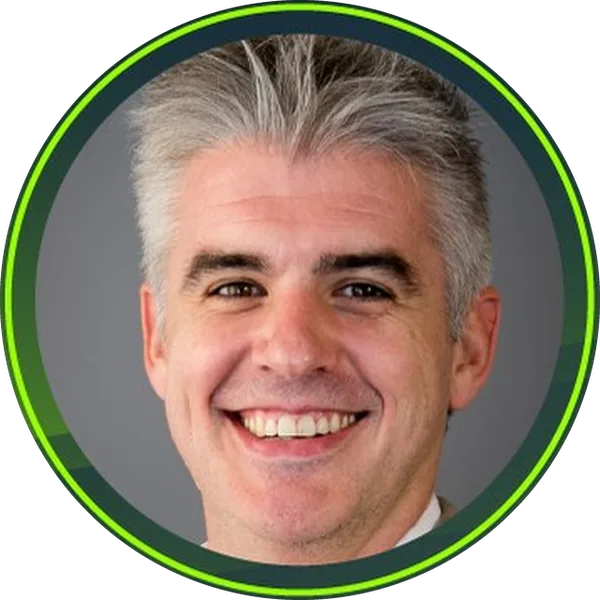
Haden Kirkpatrick
Hosts James Benham & Rob Galbraith are joined by Haden Kirkpatrick from State Farm. James, Rob & Haden discuss second & third horizon disruption & innovation in insuretech.
The full episode
Press play for the whole conversation.

The full transcript
Transcribed automatically from the episode audio, so some names and terms may be misheard.
James BenhamOn episode 96 of the InsurTech Geek podcast, talking about second and third horizon disruption with Haden Kirkpatrick from State Farm. The InsurTech Geek Podcast powered by JBKnowledge is all about technology that's transforming and disrupting the insurance world. We'll be interviewing guests and doing deep dives into specific tech we see changing the industry. We're taking you on a journey through insurance tech, so enjoy the ride and geek out. And we are here with another wonderful episode with my cohost, Rob Galbraith, who I just got to hang out with at InsurTech Connect.
What is up, my brother? Hey, man. Just living the dream down here in San Antonio. The temperature started to cool down. This is our time of year to shine. Fall is in the air. I just spent the weekend in Michigan, and it was true fall. The leaves were bright orange to red. The temperatures were down in the forties and fifties during the day. We peaked at 61 day. It was exceptionally warm. I had I even threw on a Michigan sweater just to root on big blue and enjoy the you know, I I went I went native with, with the Michiganders.
And, and Rob, I'm sorry I didn't wear Michigan State gear. I I had to I I just I need to send you one. I know. I need to get your size. We gotta get you out of that blue. I know. I look better in blue, though. I I I I like blue, and so I I threw the Michigan sweater on. It's oh, fall was great. InsurTech Connect was awesome. It was great seeing everybody there. Of course, it was great seeing you there. For for those who didn't know, Rob and I had been it's been like a COVID relationship.
We we hooked up, like, you know, we we met during COVID and we started co podcasting together. Never met each other for like two years and finally got to got to see each other in Vegas, which is a well, it's not like we didn't like leave the house. We're in Texas. Right? Texas kind of ignored most of COVID. It just all the conferences got canceled. And so we got to hang out and with us from another place that actually experiences a real fall, like an actual legitimate fall where you like the leaves turn and it you don't sweat on Halloween night.
Because, like, here, you just sweat on Halloween because you're in your costume and it's still warm. With us from from Bloomington, the mothership of State Farm. That's right. Haden Kirkpatrick. What's going on, Hayden? Not much, James and Rob. I too love the fall.
Haden KirkpatrickI think you're a little ahead of us on the season, but it's also getting very nice and crispier. And it's a beautiful area of the country. I will tell you, neither of you should wear a Michigan or Michigan State sweatshirt down here. It's not gonna go overseas. Just leave you know, hang it up, put on a jacket or a nice little woolly overcoat or something, but don't come down here wearing that junk. We'll we'll send you back up north or down south or anywhere. We'll just put you on a boat and send you someplace.
James BenhamAnywhere else. Yeah. Anywhere else. Now you you're a University of Chicago guy, I think, and then you also you went to Rose Hulman. You went to IU. So it looks like IU was the primary bachelor.
Haden KirkpatrickBut I'm I'm I'm trying to I'm trying to determine, like, what do you lay claim to as your your alma mater? Is it Rose Hulman? Oh, no. I'd say it's Indiana University. Indiana. I really enjoyed my time at Rose. It's a great engineering school, and you learn a lot learn a lot about technology, learn about math and sciences. Yeah. But engineering was just not gonna be in my future from a career perspective. I decided to go into something that's a little more people focused, a little more people oriented,
James Benhamand a little more business focused. Yeah. Now it it didn't break your way this weekend because my neighbor is a rat my neighbor in Michigan is a rabbit University of Michigan fan. I did see the score with the Hoosiers, and and it definitely was a Michigan day. I mean, 31 to 10. Sorry. Sorry about that. Now now my great grandfather by the way. Yeah. You're you are. You are. My great grandfather went to IU. You ready for his class year? I am. Class of 1888.
Haden KirkpatrickOh, my word. Well, that was back when they were good. You know, it's one of these things. It's it's a you we know we're approaching the end times when Indiana University is better at football than they are at basketball. Yes. We are living officially in the upside down. I don't think any of us are gonna know what to do it. I mean, we'll take it when we can get it, wherever it is. But, boy, it doesn't seem like we could fire on all cylinders. Big gigantic black spiders are walking around walking around there.
Yeah. It's it's tough to be a Hoosier fan right now, but that's okay.
James BenhamSo let's we're gonna talk about you for a second because we're we're we're gonna definitely geek out about State Farm and about technology and innovation. And, I mean, we're we're gonna we're gonna go down the rabbit hole. We're gonna fully go down the rabbit hole. But before we do, I wanna talk about you because you do have an interesting background. You gotta get a few different degrees. It looks like you started in engineering. You just mentioned that, and then you ended up getting a couple of degrees.
I mean, first off, where where specifically did you grow up and what did you dream of doing when you were a kid? You know, I'm a Hoosier born and bred. I grew up in the South Side Of Indianapolis
Haden Kirkpatrickand really just latched on to math and sciences in the purest sense. And I thought, you know, if you like math, you like science, you might like applying math and science. So go try and be an engineer. And, after a few internships, I just realized it was not really what was for me. So I decided to switch into political science and economics, which was a great move. But right about that time, I got a job honking phones at the mall, paying my way through college working for a little company called Omnipoint, which became Voicetree and which became T Mobile.
And in the late nineties, that industry was it was doubling every year, literally. On fire. So that took off, and I just rode the wave as long and as far as I could. Yeah.
James BenhamAnd nope. Now South Side Of Indianapolis. You know where Mooresville is? I do. I do. I spent a lot of time there as a kid at the junction Yeah. Which is a little little under 21 bar, believe it or not. You find these things in Indiana. You find these things in Indiana out on the out on the cornfields. That's where so Mooresville is where my grandfather grew up. And Oh, nice. My great grandfather that went to IU settled there in Mooresville, became a doctor there. So I have I have some I have some deep roots in Indiana.
It it it's a it's a it's a really cool place. So you grew up there. You're you you ended up riding the wave on telecom, and telecom in the nineties, you're right. Everybody went from not having mobile phones to having them. It was a major revolution, huge revenue upside, massive growth curves, pretty neat route, and it looks like you did chase that down for a while. What happened that led your way into insurance? It looks like that happened in 2015, around is where you actually made the pivot into insurance.
So what drug you into our our beloved industry? What drug me in? Kicking and screaming. Yes. Sometimes that's the case.
Haden KirkpatrickYeah. I spent fifteen years in mobile telco, ten on the carrier side, five on the technology and and sort of back office side, and felt that I had done everything that I could do and wanted to do in that industry. And I was looking around for a change, basically. And a recruiter at the time called me up and said there's this neat little company out of San Francisco called Esurance. I was, of course, familiar with the brand, and they had a quite exciting executive role there for the right candidates.
And looking at the category as a consumer and as someone with some market research capabilities, I thought, wow, you know, this is an industry that's just ripe for disruption. And Esurance is the innovation brand in the space, seemed like the ideal company with which to do that work. So I jumped at the opportunity and ultimately accepted the role in early twenty fifteen, leading the strategy and innovation team at Esurance. It was a great run. I learned a lot about the category. We went through several sort of classic innovation and disruption sprints as well as some classic marketing strategy sprints, you know, segmented the market, repositioned the brand, laid out our innovation disruption road map.
And over the course of several years, we launched several new products and services that customers really liked and appreciated, but were also good for the business. And then I eventually, I took over the customer experience and digital product function. So I had all insight to action. And that led me up right about to the pandemic. So through the pandemic, it was interesting. Got some cycles to work at Allstate on their post modernization transformation efforts. Those are still ongoing. Through the early pandemic, Allstate decided to absorb and digest eSurance, which was interesting.
And right about that time is when this exciting role came along at State Farm. So I decided to jump ship, you know, leave the scrappy innovator in the space and join the largest company in the space and try and work the industry from the top down. That's awesome. Did you actually relocate to Bloomington at that time? Not at that time. Actually, they onboarded me remotely, but we relocated, actually about a year ago this month. So September
James Benhamis when we we dropped into Bloomington. Awesome. Awesome. So tell me about what State Farm is doing. You're you're VP of innovation and venture capital. So what does that mean for State Farm and and what kind of team are you running and what are they doing there? You know, my responsibility and my mandate is to help future proof the company against these kind of disruption events. So my portfolio includes several functions that support that. We have a labs organization,
Haden Kirkpatrickroughly 200 people, give or take, that's pure technology r and d. Think blockchain, computer vision, edge computing, quantum computing. If there is a second or third horizon technology coming at us, we already have teams and proof of concept set up to help learn about it and work it. I also have two subsidiaries underneath me. One is a company called Blue Owl, which is a pure technology company. Think full cloud native, organically developed, serviced, back office insurance stack, horizontally and vertically integrated, all developed with our own two hands.
And we use that to write insurance for a company called High Road, which is another subsidiary that rolls up to me, underneath State Farm. And then lastly is the corporate venture capital function. The classic CVC function, first round totaling roughly $200,000,000, and we're working through deploying that capital now, seeking
Rob Galbraiththe best and most strategic startups in the industry that can help augment our core business and accelerate what we're trying to do. Awesome. So that's a that's a that's quite a bit of moving parts, right? I mean, you've got a you've got a lot a lot of teams and a lot of efforts, and certainly you're you're deploying a lot of capital as well all at the same time. I know that Rob has a follow-up question that'd really be relevant here. Yeah. Hayden, it's so great to have you on and really appreciate you sharing your background and the portfolio of your responsibilities at State Farm, and I've had the privilege of of knowing some of the folks that have worked in the the VC side, the lab side, and and even at, high road.
Kind of thinking about that from a strategic point of view, I wanna get down to a little bit of the the brass tacks of what does a week in your life look like for you. So those are some very lofty forward looking ambitious goals and a and a, you know, big mandate you have on your plate. So kind of walk us through like, what does that look like from a doing the the work of the work perspective?
Haden KirkpatrickThat's a great question, Rob. And before I answer, I gotta pick on you a little bit because I feel like you stole my title. There was a while where I thought I was the most interesting man in insurance. And then I saw where you made it LinkedIn official, and now I'm just you beat me to the punch. And I feel I feel like I feel like I'm never gonna be able to live up to expectations. So so what was it? What was the day a weekend in the life look like?
A day in the life is pretty well balanced. I mean, I always start off with good physical and mental and spiritual health, some exercise, healthy breakfast, some meditation, that kind of stuff. And then I try and balance the time that I spend with my teams, with my peers, and with my executives roughly evenly. I'd say I probably spend about 50% of the time with the team, 25 with my peers, and then another 25 with my senior leaders. And throughout the week, focus on our sort of end to end mandate is to focus on the consumer insights, category insights, technology and innovation research that is impacting our category or impacting the way consumers consume our category, and then figure out how we're going to address those.
This is sort of your overall decision tree on the the portfolio of work we've got. So we might be tracking a consumer trend that we think is gonna impact our industry, say, like the democratization of data. And then we will work as a collective leadership team to understand, is this a place where we wanna lead or follow or invest or both? If we wanna lead, how would we identify the right kind of startups and or efforts to bring into the lab or socialize with our peers in line of business?
How are we gonna route these concepts through the organization, helping them to see what's coming, but also prepare their business and their infrastructure to receive that? And then once we get a collective approval or sort of head nodding from the lines of business and our executives, then we get to work. There are times when some of these are point solutions, or there are times when they're so far out on the horizon, they're pretty formless. Our work with quantum computing is a good example. We know it's gonna have a material impact on our industry and on our business, but it could be any one of a dozen different ways.
And we're not exactly sure which of those ways is gonna impact first versus second. So right now it's pure R and D, understanding what it is, what the environment is, how we can develop in that environment, who are the right partners, etcetera, etcetera. Sometimes there are things that are closer on our horizon where State Farm needs somebody to pick up the ball and run with it cross functionally. Some of the work we're doing in connected home is indicative of that. Some similar work we're doing in connected car as well as what I'm calling human telematics fall into that.
So these are things that are very complicated solutions. They're taking multiple technologies and leveraging them to the benefit of our business. And there are things that impact broadly multiple different teams. But State Farm intends to and wants to lead in those areas. So we're responsible for picking those up, putting them on our shoulder, and running forward with them, almost as a innovation as a service style function. So in any given week, it could be, you know, attending strategic stand ups on some of these big deals or some of these big efforts we're working, or taking a PowerPoint deck and walking around to my peers and my executives to get broader buy in.
State Farm is a relational company. And when we decide to move an industry, we move very aggressively. But that's because we get everybody together and on board. So collectively, when we decide to move, you're getting the full force and weight of the State Farm enterprise behind those movements. It really just depends on whether we're talking far out innovation work or a little closer in innovation work. The level at which we sort of lean in and take ownership varies. Awesome. So, Hayden, let's let's talk about specific projects.
So I'm a lifelong, almost lifelong software developer. I started writing code at an early age,
James BenhamI think about 11. And I started this business. Was that Pascal? Cobalt? It was Turbo Pascal, Fortran, c, c plus plus assembly. I went to these public high schools in Baton Rouge, middle school and high school that was they were for engineering kids, and the whole school was STEM. It was pretty awesome. Well, you're a better man than I, James. I stopped at c plus plus. I was like, I'm I'm out. Oh, man. No. No. I couldn't couldn't stop. And then I started this business. We you know, we're we're a software developer for insurance companies.
So we work for carriers, brokers, TPAs, and I work on some really cool projects. I know what my favorite projects are, and I can talk about my favorite ones after I hear from you, but I wanna hear from you. And when I say favorite, I don't mean favorite because it's like a shiny cool object. I mean favorite because it just kicks butt from a business perspective. I know you haven't been in this role too long at State Farm, but you've been in the innovation role in insurance for, like, the last seven years.
So maybe maybe you can give me some more generalities, it can be across your experiences on stuff that actually legitimately because we look. You and I both know. And Rob Rob and I have talked about this. There's a lot of noise about what actually changes insurance and then there's a very small handful of things that change profitability of insurance companies, reduce risk for insureds, change the user experience, make it easier to buy, increase sales. Mean, you know, so what what are your favorite innovation projects
Haden Kirkpatrickthat you've been working on the last few years that really, really legitimately move the needle? Yeah. It's a good question. Let me let me sort of work back based on the way I think about these things and talk a little bit about what I'm observing based on some consumer research we've seen, that I think informs this. So consumers at a very, very macro level have three big problems with the insurance industry. One, it's super opaque. The customers, modern customers in particular, don't care that you have to make money.
They don't mind you have to make a profit, but they wanna know how you're pricing, what you're pricing. They wanna know where their money's going. And the insurance industry traditionally not been comfortable with that. A lot of the early stage InsurTechs that you saw, I'd argue, Lemonade in particular, did this really well. They really helped you understand, you know, as you add coverages or you increase your your limits, you can very, you can instantly see how price changes. And that helps customers really understand the price value equation.
I think the second thing that consumers really struggle with is the cognitive load and just the understanding of the business model and and how it works. Another area where insurers have not necessarily been good stewards for the consumers in this regard. At State Farm, agents do a lot of that work. In lemonade, simple imagery and very accessible language does a lot of that work, but it's all trying to solve the same basic challenge. The best and highest quality customers want to know that they're getting what they need.
They're not getting more than what they need and that they're getting it right. So if something happens, the carrier is going to be there. And then I'd say the third biggest one is the predictive and adaptive nature of products and how insurance has lagged a little bit. So there's a slide that I sort of show all of my stakeholders where I compare industry carriers versus tech companies like Apple, Google, Facebook. And the simple truth of the matter is consumers expect insurers to be competitive, but they also expect experiences to be developed, in the quality that those tech companies develop.
So they want something to be as elegant and well designed as Apple that knows them as well as Google, that is as predictive as Facebook with the logistical speed and efficiency as Amazon delivers and as curated as Netflix. Whoo. That's it? That's all you want? The insurance industry has traditionally not adapted to that. Right? It's the best of all So what happens is the consumers see these business models over here. They're transparent, accessible cognitively, and are almost so intuitive that they read their mind. Yeah. And they say, why can't insurance be like this?
And in a lot of ways, the category has kind of gotten in our own way because of that. So in the first horizon construct, I'm really paying attention to how big data is being leveraged, but not just being leveraged to improve underwriting or pricing expectations, but being leveraged to improve adaptive experiences, and how you can present to consumers the right kind of recommended coverages and packages. We are also looking actively about how those kinds of technologies can make our agency force better. But in terms of the next generation of insurance products, I'm keen to see how it evolves to really morph into covering the person as opposed to covering the assets.
In theory, there's enough data floating around in our environment where we can know more about Rob than Rob frankly knows about himself. And we could probably just click a few buttons, get some access to some of Rob's data, and give him a one shot, this is everything you need price, and you'll be covered end to end. Within this environment, State Farm's assets, brand, financial strength, claims excellence, those are all the things that are down journey. And what the customer really wants to know is that they're getting the right level of coverage for the right things, that we kind of know and intuit what they've got and know how to cover them effectively.
And that of course we'll be there if something goes wrong. And those are some of the innovations that I think are coming on in the near term that are really exciting. James, you asked about one thing that we were working interesting to me. You've probably seen the announcement between our deal with ADT. We are leaning in heavy to home telematics. We believe broadly that the home is the computing environment of the future And that home telematics is in 2022 where auto telematics was in 2004. Yeah.
So we're gonna be going in very, very hard there to make sure that we are exploring that area and getting ahead of it on behalf of our customers and that we can lend that value to them as those computing platforms become online a little bit more accessible to developers like us who are looking to work throughout the ecosystem. On home telematics, yes, especially
James Benhamwith what's going on with the number of devices that can be connected to the Internet. I've been doing I've been treating my own houses and my own test lab on this. I have Google Wi Fi, so it tells me how many devices I have connected to the Internet. I have 68 devices in my house connected to the Internet. And I've tried to automate everything humanly possible, whether it's the lights, the locks, the motion sensors, the the exterior cameras, the TVs. I mean, everything is connected in the Google Home ecosystem, but the the interesting thing has been with water.
I had a I had a rental unit that I owned that had water damage recently from the ice maker water line and it really reiterated how I need to take the water more seriously in the properties I own and so I went and I got a whole home water filter which by the way if you haven't done is amazing. It's it's got a, you know, it's automatic back flushing. It does all this stuff so you don't ever have to change the filters. It's really great. It's massive, about six feet tall carbon filter.
The guy comes in and he said, you know, if you're worried about this leaking, I can install a device right where the water comes into your house. It'll connect through Wi Fi and it'll tell you if you have any leaks in the whole house. And by the way, this guy was not tech savvy and he was explaining this to me and I said, I've actually reviewed a few of those devices. I haven't put one in yet. He goes, oh, yeah. Super easy to do. I've got it in all my houses and it automatically will shut off the water if it detects there's a leak and then they'll tell you what was what kind of leak it was.
And I was like, we've reached it. We're we're here. The the guy who's installing a water filter knows about this and uses it and knows how to install it and knows all the benefits. And this would prevent what? 80% of your water claims, maybe more. If you had all the if you had these devices installed on houses, they're readily available and your average plumber knows how to install these. I mean, home telematics, they tell you about the home, but they also can take action and prevent things from happening.
I mean, with Nest, right, if it detects that there's a fire, it'll shut off the air conditioning system so that it doesn't actually feed the fire even more. Right? Like, there's some really cool things that just consumer grade applications are doing now
Haden Kirkpatrickin the home that should materially reduce the the risk that you guys have. Right? Yep. That's the general thesis. So we've already proven this concept with electrical fires with our investment in Whisker Labs and our testing of the Ting device. Yeah. Which, if you don't know, is a device that's super basic. You just plug it into an outlet, and it can read electrical signals and specifically identify potential arc failures and then intercept by sending an electrician out to repair those. We've saved I can't disclose the exact number, but we've saved a lot of homes from catching fire in those environments, and that leads us to believe that these kind of preventative measures are accessible to us.
Same thing with with water detection and shutoff. Those are areas we're gonna be exploring along with our partner at ADT. And then, of course, ADT is well positioned for theft, cameras, and other things that we can get. But I would also argue that, at least from our perspective, home telematics goes way beyond loss mitigation and impacts the entire journey. There is data that we are bringing in from public, private, state, and third party data streams to help gauge the quality of your home, where there might be potential loss vectors in the future, where you might have opportunities to make your home safer or more sustainable.
We can read all of that data from publicly available information, And we're basically putting together something akin to a Fitbit or credit score for your home. And in our early research, customers have indicated an openness and willingness to actually purchase things from State Farm that help make their home safer and more sustainable as a marketplace. Right? So the way that a lot of, say, classical tech companies look at these spaces is they think about the home as a computing center, as I mentioned, but then they don't stop at the walls of their company and how they're going to go about solving for what they can do in a home.
There is comfortable partnering with a third party or another, you know, startup or another big company, to incept the kind of value props and solutions to real life consumer pain points that they need. And that's the way State Farm's thinking about this. We don't have to manufacture all this stuff ourselves. We don't have to produce it. But there are things where State Farm's brand and our halo and our trust and our agency network and all the things we bring to the table, can actually lend that consumer value and help the consumers have trust that if they they engage with us to make their home a safer and more sustainable place, they'll get good product, good value, and that'll ultimately reinforce their insurance experience, save them some premiums, and maybe keep them protected from losses in the first place.
That's
James Benhamawesome. Really interesting. And I I wanna wind back to something you said at the beginning of your sentence where you were talking about the partnership with Ting. You're not the only insurance provider that's doing this, but you're definitely one of the pioneers on partnerships like this. Do you see yourself having an entire app marketplace and device marketplace where said you said your customers are getting accustomed to buying things from you that protect their home. Does that mean that you're going to be offering the entire array of home IoT devices?
It's kind of a package if you get insurance you get these these things, or you're gonna get them at a discount. I mean, what does that mean long term? Yeah. Those are things we're testing now with our ADT partnership. We already have a proof of concept up in Indiana that we are evolving. And then the partnership that
Haden Kirkpatrickwe initiated with them includes an opportunity fund for new product, new service development, and how we can evolve that. We're also very closely monitoring what's going on with the Matter Protocol. Because as you know, James, I don't I don't know what kind of connected home technology you've got, but I must have four or five, different brands, right, surrounding my home ecosystem. Mhmm. Same here. And being able to extract I'm I'm sure. I I imagine of the 60 some odd pieces of electrical equipment, you've got something from Sony, something from Samsung, several things from Apple, maybe something from Amazon, some Google stuff.
And so, you know, for consumers to be able to give us the data that we need and get benefit from it, we need some sort of interoperability platform and third party data sharing platform that we're looking to stand up and move forward very quickly with there. After that, they're classic testing and learn, classic experimentation, human centered design sprints will help us understand what consumers actually want. But just generally speaking, going back to earlier in the conversation when I referenced my history in consumer research here, consumers want value from anything they buy.
In insurance, you know, the value has traditionally been a promise. In the event that something does go wrong, we'll be there for you. But there's an opportunity for us to say, you know what? There's a whole lot more value around your home or around your car where the insurance company's assets can lend that value for you. And it's our general perception that, at least from early research, consumers give us the benefit of that brand halo when we do bring those things to bear. Yeah, exactly. Yeah.
The interoperability
James Benhambetween the devices is the part of that comment that I think is one of the more interesting ones that comes back to one of the most important arcs, think, any carrier is how you actually unify all the data coming off all of this, right? And what you do with it and how you make better decisions and how you use that for underwriting. I'm sorry if I latched onto that. Know it was an early comment and what you just said, but that's as a technology, that's one of the more interesting parts in particular, like if I already am going to buy or consume some of these devices before I even show before I even show up to your doorstep.
You know, like I before we got on this call, I went to State Farm and I got a quote for my for my home just to just to see what your quoting process was like. You're, you know, you're using some nice third party data sources like a lot like a lot of other folks, but it would be interesting if it was like the partnership I have on my car with OnStar, where they already have all my driving data and then they ship it to the insurer.
Then I have to, you know, retroactively they have the they have the historical data straight out of the box if there's a common platform for exchanging that data. Yeah. Totally agree.
Haden KirkpatrickThe analogy that I use for my teams and our leaders, I assume you all follow fintech, not like Insurtech version, but like banking tech. Yep. Right? Yes. You know, you go into any new app, literally any financial app that's been launched in 2,008, and you go in and you can establish a connection to any banking relationship you've got. You just hand over your credentials. It's tokenized data starts streaming. Acorns is my favorite example, right? I've got every bloody bank account that I've got every credit card account linked to Acorn.
And that data is flowing and it's an incredibly thin experience. You just username, password, authorize. Maybe if you've done the right thing and put two factor authentication, you check your text messages, but otherwise, you're in. The same thing's true of any fitness app or health app you've got. They all talk to each other. So if they can do it in banking, and they could do it with health care and health records, Surely we can do Surely.
James BenhamSurely. Don't call me Shirley. You know, it's yeah. No. No. Sorry. I was watching your plane recently. I mean, surely, I agree. There there is a future in which we can do this. Now we are running out of time, so I just wanna give Rob the final shot at the last, last comment or a brief question here. Yeah. Just great discussion, Hayden.
Rob GalbraithObviously, I think we could continue this conversation for for hours and, you know, I always try to give everyone that sense of, right, we're having a beer and we're actually naturally talking about these things, right, which you can choose to believe or not believe. I actually do think the three of us would be exactly those types of people that would would do that. Right? So, you know, you mentioned home telematics, you you mentioned some other technologies, right, blockchain in there. And so when we talk about second and third wave, you know, one of the things that I love about your background is is not being tied to the insurance industry, right, for your whole career the way essentially I've been.
You've got experience building products with mass market appeal. You've used the term disruption earlier. So what do you believe are some of these larger trends? What does that future look like? I don't want to put a timeline on it, let you, but five, ten years when you talk about second and third waves. Maybe paint a picture for our audience again. I know that's probably a fairly detailed question that you could go at lengths for, but would just love for you to maybe summarize and paint a picture for our audience.
Haden KirkpatrickYeah. You know, it's a great question, Rob, and this is one that is always better over beers or maybe something a little stronger. I see sort of two events in front of us, right? There is short to midterm. I think winter in InsurTech is here. I think you've seen the tech portion of that category get usurped by the insurance portion of that category. And I wouldn't be surprised if we see a whole lot of consolidation in the down market. Or technology is kind of a I hesitate to say, but technology, if you're starting from scratch, is kind of the easy part of the InsurTech equation.
It's pricing risk, which can be difficult. So all of the major carriers are trying to catch up with the InsurTechs and they can do it either by trying to replicate, partner, or acquire. But those companies, especially the public ones, they're they're insurance companies first, foremost, and finally. And I bet there's going to be a pretty gnarly round of, consolidation and or extinction that's coming over the course of the next two to three years in in that short to midterm context. The thing that really keeps me up at night, Rob, you know, insurance is a category.
If you think about, say, Web one point zero, Web two point zero, the moats and the walls that surrounded our category were so wide, so deep, and so tall that it's just going ecommerce, difficult to do from scratch, difficult to get stood up in a way that allows you to be compliant. I mean, this was Esurance's thesis, right, and it was a '20 endeavor. The sort of web two point zero version where you have more ecosystems, more collaborations, data sharing, some of the things that we were talking about on the call here, consumers as creators and vice versa, right?
That's an area where insurance as a business model, an industry, think we could all see how that might work, but it's very difficult from a regulatory perspective and from a consumer cognitive accessibility perspective. So those are areas where, as those two macro market technology trends were disrupting whole swaths of the economy, insurance is kind of preserved from it and defended from it based on the natural nature of the business. The sort of web three point zero, web four point zero technologies that are coming on, I do not think will have that grace.
You know, they're ten to twenty years out, but they are more fundamentally disruptive to what we do. Like blockchain, quantum computing, edge computing, some combination therein, you know, with an IOT layer in between as kind of your core platform of the future, whatever those are, however they combine together to enable that platform will hit insurance from, you know, the moment it scales. I don't see a lot of grace coming on that next horizon for us. And we have to be way ahead of it as industry professionals.
So we are actively looking at what is that computing platform of the future, and then what are the kind of computing applications of the future of which I'd say metaverse is one, blockchain might be one, depending on how you look at it. It all kind of blends together in the middleware. But those are areas where, you know, we got to stay way ahead of that curve. Because in the event that those do get scaled and in the event that a new insurance company or a new InsurTech really leans into that back office of the future and gets well capitalized, it could be really hard on legacy carriers and trying to port oak.
That's not one where you can catch up quickly, right? You better by God be prepared before it hits. Otherwise it's gonna be a real, real hard, hard path forward. So those are the things that keep me up at night, frankly. Yeah, well,
James Benhamit should keep you up at night. Although I'm going to say, I'm going to say, you said the technology is not the hard part, but the interesting thing is I've spent twenty one years working with insurance carriers and TPAs fixing botched implementations of policy and claim systems that they've spent hundreds of millions of dollars on. And I would say technology is one of the hard parts because when you see people with implementation budgets of a quarter of $1,000,000,000
Haden Kirkpatrickfor new policy systems and they still fail, you you you have to ask yourself at some point, hey, maybe technology is the hard part. There is a there is a challenge sometimes. Now now, James, were they trying to port their old business into a new technology environment? Because that might be, you know, where I've seen a lot of this stuff is that the the 80% that really makes the business work isn't what they port. They port a 100%. Yeah. And that last 20% is a lot of calories burned.
It's the monster, isn't it? Well, look, great discussion. We are out of time, but Hayden, you're a gem.
James BenhamBut I tell you what, Rob and I need to come up. We need to come up to your town and and come come check out this lab and meet some of these people and and come have a visit. So I hope we can we can come and see you in person. Well, we'd love to have you and we can do a follow-up. We can do a follow-up podcast IRL next time. In person. In IRL. Yeah. That's in real life and meet in the meat space, not the metaverse.
I love it. So, yeah, I I agree. Well, look, thank you so much for your time today, Hayden, and thank you, Rob, for as always, co hosting, and thank you out there in listener land and for tuning in to geek out our interview with Haden Kirkpatrick from State Farm. This has been the InsurTech Geek podcast powered by Jimmy Knowledge. That's jimmyknowledge.com. It's all about transforming and disrupting the insurance world. I'm your host James Binnom, that's jamesbinnom.com with co host Rob Galbraith, that's endofinsurance.com. Big thanks to Jim Greenlee, our podcast producer, Cara Dalton Alero, our creative producer, and thank you for joining us today.
We're taking you on a journey through insurance tech, so enjoy the ride and geek out. See you next time.